
1 The problem
90% of drugs fail in human trials.
30% of them fail because of unforeseen side effects. This is an incredibly costly endeavor: big pharma reports that one failed drug costs $1 billion.
We believe that through more accurate computational models of disease, we can pick better drug targets by predicting their side effects early. This would increase the success rate of all the following stages in the drug development pipeline.
Figure 1
Probability of success across the drug development pipeline
a Today
b With better target identification
2 Existing methods
The limits of existing metabolic models.
- 1 Genome-scale metabolic models
-
- Limited causal discovery, since they are based on knowledge bases of isolated interactions.
- Limited by the steady-state assumption (a stable flux of 0), which cannot capture disease progression from a healthy state, since that involves flux changing across time steps.
- 2 Equations derived by hand
- Very poor modeling accuracy, as Costello and Martin (2018) showed.
3 Our approach
Neural differential equations for metabolic simulations.
Toward the vision of accurate computational models for human biology, we developed neural differential equations (NDEs) for metabolic simulations.
On time-series multiomics data from engineered E. coli strains, our NDEs cut prediction error by more than 90% on both the limonene and isopentenol pathways, and ran inference 1000× faster than the existing machine-learning baseline.
Figure 2
Predicted metabolite dynamics on held-out strains
a Acetyl-CoA
Limonene pathway

b HMG-CoA
Isopentenol pathway

c Isopentenol
Isopentenol pathway

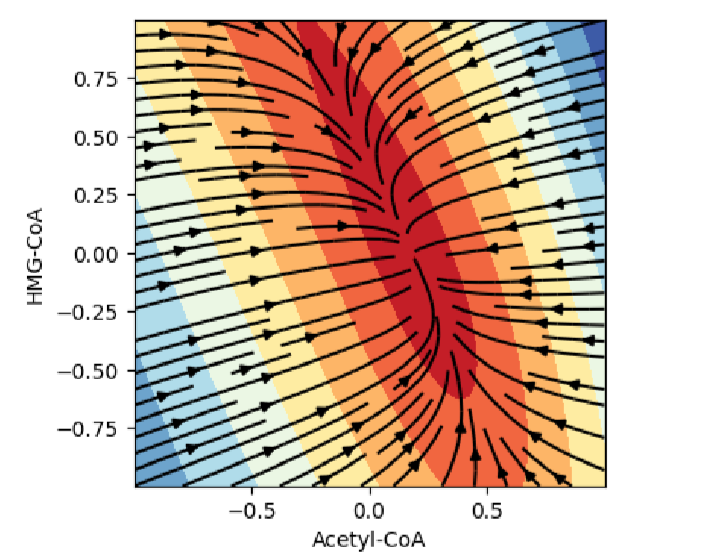
Figure 3
A learned vector field
4 The team
The team

Andrei Lixandru on LinkedIn
Project lead
Coordinated the NDEs project and co-authored the preprint.
AI scientist trained in leading AI and computational biology labs, with a track record of innovation in machine learning research (FrODO, axPPO, NDEs).

Udesh Habaraduwa on LinkedIn
Machine learning researcher
Turned NDEs for metabolic simulations from an intuition into a rigorous scientific study, showing the promise of physics-informed neural networks for simulations in biomedicine.
PhD researcher and host of the One Deeper podcast.
Contact
Get in touch.
For questions about NDEs for metabolic simulations or the preprint.